Tuesday, August 13, 2013

Living on the Edge: Takashi Miike's Black Society Trilogy


            From the opening frames of Shinjuku Triad Society (1995), with its bustling montage of crime, fringe-dwellers, and illicit back-alley liaisons, to the melancholy downpours of Rainy Dog (1997), and the closing song and sunset of Ley Lines (1999), Takashi Miike’s Black Society Trilogy is a gritty, uncensored journey into the abyss of alienation and loneliness that lies at the very edges of society.

            The ‘yakuza’ film is as entrenched in Japanese culture as the ‘gangster’ film is in ours. Movies like Seijun Suzuki’s Tokyo Drifter (1966), and Akira Kurosawa’s Drunken Angel (1948) have cemented the genre’s staying power just as well as The Godfather (1972) and Goodfellas (1990). However, Japanese gangsters have a distinctly different way doing things that makes their world seem all the more seedy and sinister to Western viewers.
            And beyond this difference even further we find Takashi Miike. Where before was a shady, but structured underworld of crime bosses and foot soldiers, cops and dealers, pimps and prostitutes, we now find under Miike’s direction a blur of lines and a frightening chaos that mimics the real world perhaps a little too well on the one hand, and yet seems directly out of a cartoonish nightmare on the other.

            Although now well known for his shocking depictions of horror and violence in films such as Audition (1999) and Ichi the Killer (2001), as well as historical epics like 13 Assassins (2010) and Harakiri: Death of a Samurai (2011), Miike’s first work was a redefinition of this yakuza genre that had been so well established in Japan for decades. The Black Society Trilogy is comprised of these three films: Shinjuku Triad Society, Rainy Dog, and Ley Lines. This trilogy is not one in the traditional sense. Unlike Star Wars or Jurassic Park, Black Society is not a film and its direct sequels. Rather, in the tradition of Pasolini’s Trilogy of Life, or KieÅ›lowski’s Three Colors, it is a trilogy linked by themes and motifs. Here specifically, the chief theme is alienation.

            The first, Shinjuku Triad Society, follows Tatsuhito, a dirty cop who is working to bring down a gay crime syndicate known as the Dragon’s Claw Society, only to find out that his younger brother has become the group’s lawyer.

            Rainy Dog centers on Yuji, an abandoned foot soldier for the mob who must now take work in the form of a contract killer-for-hire. Things only get more complicated when a woman he hasn’t seen in several years saddles him with a young boy she claims is his son.

            Finally, Ley Lines finds three mixed-race youths struggling to make ends meet by selling toluene. They finally discover a possible way out of their dead-end existence by robbing the crime boss they supposedly work for.

            Takashi Miike explores alienation and loneliness throughout each of these films in three distinct methods. These methods are present in all of the films, each in their own way, and never are they mutually exclusive. It is in this way that the director ties the trilogy together by its themes.

            The first is a marked separation of the main characters in each film from the society around them. Every character has traits that contribute to his/her alienation. In all cases, the result is not ‘me against the world’, but a profound loneliness that permeates every decision, every action taken. Often, this culminates in the worst of choices predicated on the desperate hope of a connection with someone, something, somewhere.
            In Shinjuku Triad Society, Tatsuhito is outside of every norm. He is a detective, but corrupt, and therefore outside the law. His is half Taiwanese, half Japanese, and therefore has no national identity. His brother works for the crime syndicate he is trying to bring down, which tears his family apart. He very literally has no place to call home. This emptiness drives him to the most reckless extremes in an attempt to reconcile his broken relationships.
            Rainy Dog sees Yuji expelled from the organization he has always worked for, perhaps the worst disgrace for a gangster! To be considered so utterly useless and unthreatening as a henchman that you aren’t even whacked, you’re fired! This is compounded by the obviously empty proclamations of love and kinship that his new employer professes when contracting Yuji to kill this person or that one. The disconnectedness of it all is underscored by the blithe muteness of Ah-Chen, his son, who follows his father everywhere but never says a word.
            The three youths in Ley Lines find their separation from society in their fractured nationality – half Chinese, half Japanese. It is startling to find such discrimination in this cinematic underworld where a gun is all that is needed make every man equal. Indeed, the group believes this to be true, only to find out firearms aren’t all that rare. What happens when the other guy has one too?

                As a sort of counterweight to the traits that force each character into alienation is Miike’s juxtaposition of this solitude with the acceptance and cohesiveness of groups just out of reach. These arise in the form of those who lead and follow. There is an eerie and agonizing similarity between Yuji’s son as he draws a gun in chalk on the sidewalk (Rainy Dog) and the mob boss Wang’s ‘pet’, who scratches a phallus into the desk, chanting about his ‘favorite thing’ (Shinjuku Triad Society).
            Often, we have to question the desire for belonging in Miike’s world, where unity and brotherhood seem to go hand in hand with murder and betrayal. It seems as though the striving to part of something is the driving force behind the pain, suffering, and inevitable downfall suffered by all of our protagonists.
            It is the camaraderie of the Dragon’s Claw Society that takes Tatsuhito’s brother away from him, just as it is the desire for a family that drives Yuji to confront the enemies hunting him, and three friends to risk everything for a chance to escape their situation.

            Finally, and perhaps most poignantly, Miike explores alienation through the past, present, and future. At last we see the prime difference between each film.
            Shinjuku Triad Society examines the past. Tatsuhito battles aggressively throughout the film to regain the family he has lost. He dwells in what was before, and it informs all of his actions. He gives his money to his parents, he chases his brother to the very depths of the criminal world just to bring him back and make his family whole again. In many ways, this is the most desperate and angry of the three pictures, as though nothing can equal the fury of a man who has lost grip on all that was dear to him.
            Rainy Dog is the present. Yuji has the opportunity here and now to forge a connection, a family to belong to. Who cares if that family consists of a mafia hitman, an orphan, and a reformed prostitute? Yuji’s persistent attempts to get out of the rain whenever it falls symbolizes his need to be sheltered by someone, anyone. But he finds his purpose, in the end, is to be the one who shelters someone else. He embraces this even with his final act, the shielding of his son from a hail of bullets.
            Lastly, the future. Ley Lines is built upon the quest for something better, somewhere else. It is most fitting that the ending of this film is the most uplifting. In spite of the death and loss, the last remaining character, with his new love interest, rows out to sea singing an old nursery rhyme. The gamble of robbing a crime boss could only be thought possible by the ignorance of youth, yet it is this zeal for the future that sets them apart. There must be something better around the bend.

            Takashi Miike’s Black Society Trilogy does not really offer much in the way of answers to the questions it poses. But maybe that is okay. The struggle against alienation and the desire to belong are forces within each of us. Perhaps that is the reason these films resonate so well with us when we see past the violence and grittiness. Deep down, Miike seems to say, we all need to care for something.


Tuesday, July 2, 2013

Prelude to the Sighs: Dario Argento's Suspiria


            A girl runs dashing into the rain. She hails three taxis before one stops to pick her up. There is nothing blatantly out of place with the scene, yet it is unnaturally bathed in dizzying red and green and yellow glows. Slowly, distantly, emerge the strains of jarring, erratic music layered over discordant, whispered voices – “La la la la la la… WITCH!!!” And so begins the delirious trip down the rabbit hole that is Dario Argento’s Suspiria (1977).

            Suspiria has often been labeled as Argento’s career-defining masterpiece. The legions of fans devoted to his unique filmography are frequently divided between this film and his preceding giallo opus Deep Red (aka Profondo Rosso) [1975]. In the mid-1970s, Argento was undeniably at the height of his career. His first film, The Bird with the Crystal Plumage (aka L’ucello dalle piume di cristallo) [1970], announced his presence as a major new talent. But after half a decade of being the ‘Italian Hitchcock’ it was time for a change.
            Suspiria, roughly translated ‘the sighs’, was a major departure for Argento in almost every way. Aesthetically it retains many benchmarks of his early works, yet exaggerated by vibrant colors and even more so by practically tuneless jazz-influenced music by Claudio Simonetti. The most dramatic shift is thematic. Where every preceding film Argento made centered on the giallo blueprint of stylized violence combined with Hitchcockian mystery, Suspiria takes a sharp left turn into the supernatural.
            At its core, the film is a simple story. Suzy Bannion comes to Germany to enroll in a dance academy boarding school, supposedly the best in Europe. There she encounters strange happenings – maggots, drugged wine, disappearances, and murder. And the otherworldly suspicion that her school is run by a coven of witches!
           
Art is not often synonymous with horror filmmaking. Cinematic explorations of death or evil are so many times relegated to easily digestible personal dramas or historical epics. Films such as Spielberg’s Schindler’s List (1993) make ample use of evil as a thematic element or dramatic subject. Yet it is this self-aware philosophy aimed at making sense of the senselessness that drives such works from sincerity into the realm of pretense.
Central to the effectiveness of Suspiria is its preoccupation with evil. No rhyme, no reason - just evil for evils sake. This is what sets the film apart from the pretentious ruminations that occupy your modern neighborhood cineplex. In truth, Argento’s movie doesn’t seek any sort of answers. Witches commit evil because they can and that’s it. There is no mystery to it. Perhaps the art of the film is revealed because of this stubborn refusal to explain anything.
The only scene of exposition to be found (where Suzy goes to meet a professor to find out about witchcraft) does not really provide all that much information beyond what we need to know. In fact, it serves primarily to further the audience’s sense of foreboding, rather than lend any explanation to the seemingly unconnected series of murders and strange happenstance.

This does not mean Suspiria does not have a plotline, it does. It’s just a very simple one. The fact of the matter is that story just isn’t the point here. What is happening and why takes a backseat to the aesthetic look and feel. This is classic Dario Argento.  In a day in age when plot is considered paramount, this may seem off-putting to the everyday viewer. But one willing to delve a little deeper will find that dazzling, psychedelic wonders await within.
Anyone familiar with the director’s work knows the signature one-two punch of sight and sound that identifies a picture as an ‘Argento film’. For all the departures from form to be found in Suspiria, the aggressive scoring and indelible visuals (including the trademark ‘hands of the murderer’ sequences) are completely intact and better than ever! No filmmaker understands the potential of color like Dario Argento. Here every frame is awash in neon hues. The resultant mesmerizing color palette is as responsible for setting the mood in each scene as the actors and actresses. The steady camera work is remarkably precise, yet never feels forced or unnatural, realizing each frame as its own sort of moving still life. The end product is a film that seems a sort of living, breathing watercolor painting filled to the brim with fairy tale horrors beyond count.
            Just as responsible for this artistic impact is the score composed by Claudio Simonetti and his instrumental rock band Goblin. Having previously been discovered by Dario Argento and employed for Deep Red (aka Profondo Rosso), Goblin provides an electric, aggressive sound that not so much compliments a film as it assaults the viewers ears.
            In Suspiria, the soundtrack is a startling amalgam of electric rock, experimental free-form (á la The Doors’ Horse Latitudes), and avant-garde jazz. The music fades in and out at odd and inopportune moments. The effect is the audience is kept in a state of unease that works expertly to the films advantage.
            The title theme ‘Suspiria’ is sensual, childish, and evocatively unsettling. Like the children’s lullaby in Deep Red, it is used to telegraph the unknown. The simple melody played on a glockenspiel calls to mind a music box with a dancing china ballerina – oddly appropriate for a film set in a dance academy, and yet inexplicably ominous at the same time.

            The combined effect of audio and visual is an off-balance sort of atmosphere, as though the audience has been transported suddenly into a sinister sort of déjà vu fairy tale. A waking nightmare of witches, murderous illusions, and rooms filled completely with barbed wire. Such evil depicted with callous disregard for decorum often descends into exploitation and throw away double bills such as Torso (aka Il corpi presentano tracce di violenza carnale) [1973] or Thriller: A Cruel Picture (aka Thriller- en grym film) [1973] – both of which feature an endless barrage of salaciousness, depravity, and violence.
            Yet Suspiria circumvents these conventions while somehow simultaneously displaying the evils they shamelessly exploit. Therein lay the art of the film and the brilliance of Dario Argento. He seems to understand the deep-seated psychological roots of human fear – the unknown, the supernatural, the mystical – and the need for us to vent these apprehensions vicariously. The colors, sounds, conspiracies, dark corridors, unexplainable bumps in the night… All serve to channel our subconscious fears and turn them into an onscreen experience. This is the art of Suspiria.

            After the film’s success, Argento would continue his career with many successful films in the 1980’s and 1990’s, including Inferno (1980; a sequel to Suspiria), Tenebre (1982), and even films starring his daughter Asia Argento like The Stendhal Syndrome (1996). But in spite of the brilliance of these later works, none would match the operatic power and artistic heights of Suspiria.
            Like all of his films, Suspiria cannot simply be watched, it must be experienced. Truthfully, despite the author’s best efforts, this analysis is woefully inadequate in doing the film justice. Quite simply, it is a ‘must-see’!
            So go check it out! Like the iconic poster declares: “The only thing more terrifying than the last 12 minutes of Suspiria, are the first 92!”


Monday, June 17, 2013

God's Will: The Last Temptation of Christ


            Let me begin by first saying that the Jesus Christ I believe in, have given my life to, is definitely not the person that is the focal point of director Martin Scorsese’s The Last Temptation of Christ. But neither is he Scorsese’s picture of the Son of God. The image of Jesus presented here is the central character to Nikos Kazantzakis’ 1953 novel of the same name. Indeed, the title card says as much when the film begins – “This film is not based upon the Gospels but this fictional exploration of the eternal spiritual conflict.” So it is not about Christ at all, really, but instead about the internal struggle in all of us, as humans, to understand the divine and, in light of that divinity, to discern our own purpose.

            I must admit, even before I saw the film, I was confused as to why there has been so much controversy over it. At heart, I am a very intellectual person and therefore have never been able to escape the thought that all we know about the life of Christ comes from a book written by several different people, all from their own respective points of view nearly two thousand years ago. Add to that the fact that the original transcripts of these writings are long gone and the versions we have now have been translated and translated and translated so many times at varying degrees of accuracy that the result is essentially tantamount to a sort of millennial game of telephone. Just stop for a second and think: how badly does a single phrase get botched when passed around the room for five minutes between fifteen people? Now multiply that by two thousand years, dozens of languages (some no longer spoken), practically seismic shifts in the way doctrines have been interpreted, and then filter that through the lens of science and sifter of history. What do you have? The answer is simple: Faith.
            Faith that the God you worship has preserved His message for generations upon generations. Faith that you have been endowed with sufficient faculties to pick apart and understand that message. Faith in the purest, simplest sense. From this perspective, The Last Temptation of Christ may very well be the most accurate and profound depiction of the person of Jesus Christ ever committed to film because it is the only film that deals with the heart of the struggle we have as humans to have faith in a God so far beyond our own comprehension. Every other film I can think of that deals with the life of Christ centers on his actions. From Cecil B. Demille’s King of Kings (1927) (and its 1961 remake) to The Greatest Story Ever Told (1965) to The Passion of the Christ (2004), all of these films relate the life of Christ – his miracles, his teaching, his death, and of course his resurrection. But The Last Temptation of Christ is the only one that endeavors only to explore the person of Christ, specifically his humanity.
            The point in saying all of this is to implore each viewer to take the film on its own terms. As an individual work of art it does not claim to portray the Jesus of the Bible, nor does it desire to slander God and those who follow Him. Rather it is a filmmaker’s own personal faith journey. Unlike the purposefully satirical Monty Python’s The Life of Brian (1979) or the terrible, blatantly antagonistic Year One (2009), Scorsese’s film does not seek to be irreverent nor does it desire to rewrite Scripture. It wants to wrestle with the mystery of Christ – the paradox of someone completely God and yet completely human. Like Kazantzakis’ novel, the film does not pretend to have answers to its questions. And it certainly does not build itself upon a proselytizing of beliefs.
            For every license taken with the Gospel story, there is a scene dramatized directly from the Bible. The Sermon on the Mount is a wonderful example! After saving Mary Magdalene from stoning, Jesus tells his first parable. The scene is inspiring and recognizable, and innocently punctuated by his audience’s humorous misinterpretation of his message, “Kill the rich!!!” “No wait, I said LOVE! Not kill!” In one short moment, the film seems to be self aware; as if it knows that it is being scrutinized. If they ‘get it wrong’, so what? Jesus’ own audience missed the point even when they were there to hear it! The Last Temptation of Christ is endeavoring to wrestle with Christ’s humanity, and it is not afraid to make mistakes along the way.

            Truthfully, what better way to wrestle with the human nature of Christ than to examine the temptations of being human? The titular last temptation is not in fact a sin as we would understand it. The Jesus of the film is not tempted to steal, murder, or slander. He is tempted to live a normal life – a life with a family, a good wife and children and grandchildren. This ideal is in fact one of the great goals of life that we are all taught from an early age. This is what to strive for! Yet for Jesus, this temptation would mean abandoning his purpose, and condemning the world to an existence apart from God.
            Scorsese chooses to portray Jesus Christ as a man unaware of his divinity. If the films decriers were to choose an aspect to focus on, this should probably be it, instead of the temptation sequence at the end of the film where Jesus glimpses what could await him if he should choose to give in and live a normal life. There is a certain, unavoidable logic to the concept of Christ as we understand him. To be completely God as well as completely human, he must be unequivocally aware of his identity as the Son of God.
            In spite of this, the director’s decision to portray him as unaware serves as a marvelous template for which to paint his picture of the human versus divine struggle within each of us. In the film, the divinity of Jesus is revealed as he finally commends his spirit to God and willingly becomes the sacrificial lamb for humanity’s sin. In his mind’s eye he screams, “I want to be Your son! I want to be the Messiah!” And then, it is accomplished.
            It is as if Scorsese is telling us that to overcome our humanity, we must give ourselves to God. The struggle between two halves is not truly a struggle at all, but rather our own stubborn resistance to the will of God, and the plan He has for our lives. This is stated no plainer than in an early scene where Jesus is talking to his mother Mary. He hears a voice telling him he is more than he seems. Fighting it causes him great pain, and Mary says, “How do you know it is God? What if it is the devil? Devils can be cast out.” And Jesus replies, “What if it is God? You can’t cast out God, can you?”
            Indeed you cannot. That is the story of the entire picture. No matter if Jesus chooses to disobey or not, God will not leave him alone. He goes through phases trying to understand God’s will and carry it out. First he believes his message is to be exclusively love. After his fasting in the desert, he tries to marry love with action, with revolution. Yet neither of these concepts, together or apart, is enough to satisfy the drive to reconcile his humanity with God’s nature. He finally comes to the idea that he must sacrifice himself to gain this reconciliation, though he does not understand why he feels that must be so. In the end, all of his attempts to understand are revealed to be the same sort of resistance. Understanding is not so much attained through doing as it is through abandoning one’s self to the love, mercy, and divine plan of God.
            When Jesus declares, “I want to be the Messiah!” he is not making the declaration of himself as an ultimate purpose or defining action. What he is really revealing is his final willingness to be whatever God has meant him to be all along. He is giving up his resistance, his humanity, in order to give himself fully to God. It is in this that he is revealed to be God, because who truly has the power to do such a thing, except the Lord himself?

            In the end, The Last Temptation of Christ is not about Jesus. Therefore it is not a heresy. It is about us – about our own constant resistance to God. Our own inability to comprehend a Creator that loves us, judges us, gives us grace, and asks only for love in return, yet wills us to reach beyond ourselves. When you watch this incredible, soul-searching film, remember: It is not Jesus Christ you are seeing, it is your own duality, the human and spiritual natures that make you a child of God.

Monday, April 1, 2013

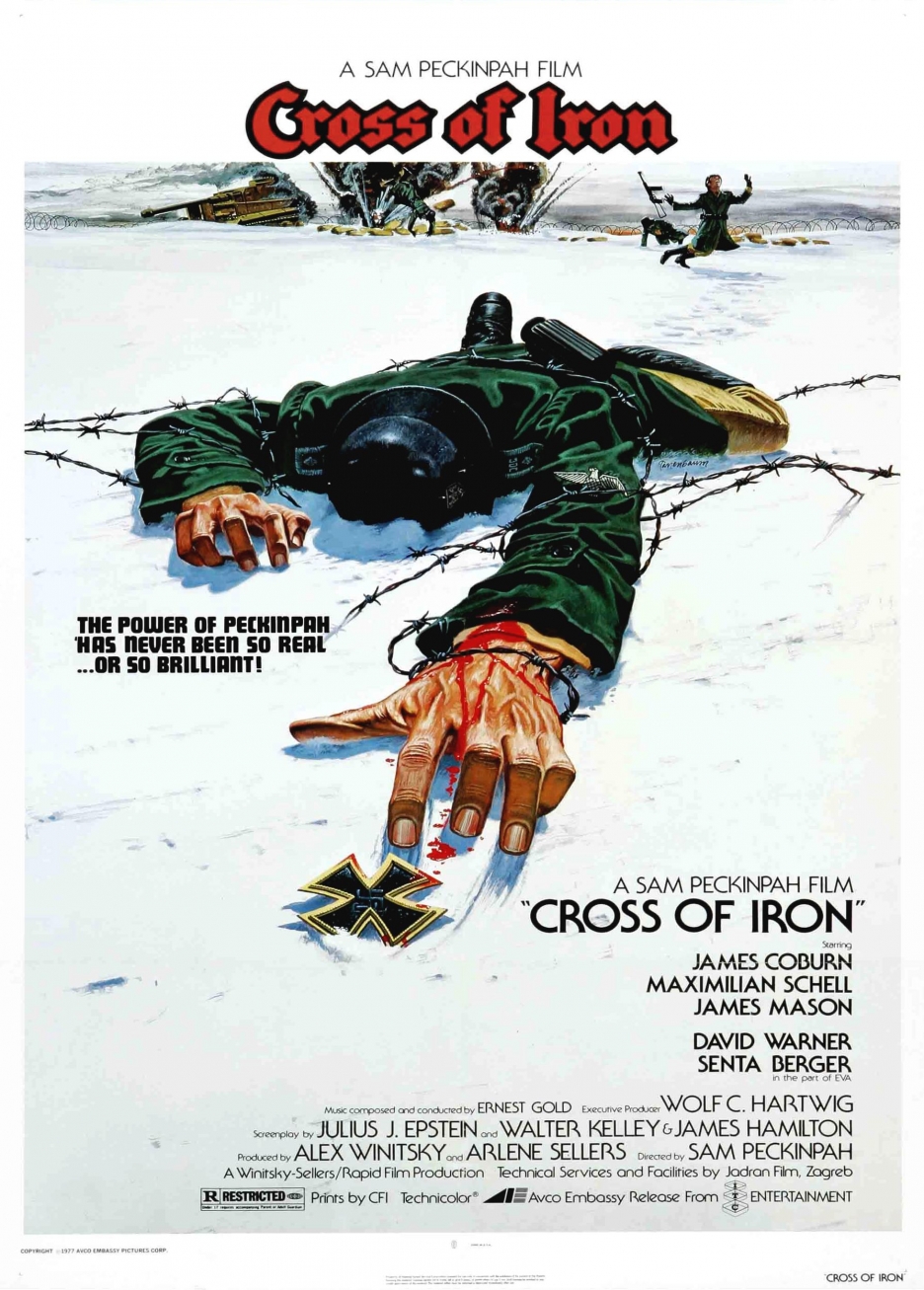
Growing Violence: Peckinpah's Cross of Iron


            The War Film, just like any genre of filmmaking, has a distinct ebb and flow to its popularity. Horror cycles through stretches of slashers, hauntings, and remakes both foreign and domestic. The current phase for romances seems to be an endless output of Nicholas Sparks adaptations and comedy is indisputably ruled by Judd Apatow and Seth Rogen. For the most part, every genre of film is always in some way present. War, however, is unique in that it goes through long periods without being present at all. These ‘dry spells’ – arguably the result of social and political atmosphere – are almost invariably followed by sudden floods of films, often kicked off by a new and daring entry in the genre.
            A few examples of this… the 1960’s were filled to the brim with patriotic films about World War II. Aside from the lesser known genre from Italy known as ‘Macaroni Combat’ (obviously a pairing with ‘Spaghetti Western’), the 1970’s does not boast a wealth of war films. Now, before you yell out Apocalypse Now (1979) or The Deer Hunter (1978), I am compelled to state the former is at its core a creative adaptation of Joseph Conrad’s Heart of Darkness and the latter is much more about life after Vietnam, not the war itself. In any case, it was not until Platoon (1986) won four Academy Awards and opened the gates for a rush of pictures about the Vietnam conflict that the genre exploded once more. Incidentally, a very similar situation was created for a second time with the release of Saving Private Ryan in 1998. Since then we have had The Thin Red Line (1998), The Patriot (2000), Band of Brothers (2001), Enemy at the Gates (2001), Black Hawk Down (2001), The Lost Battalion (2001), Windtalkers (2002), We Were Soldiers (2002), The Last Samurai (2003), Flyboys (2006), Flags of Our Fathers (2006), Letters From Iwo Jima (2006), and finally The Pacific (2010) – a late-comer to be quite honest. Things have arguably slowed down again (the only entry of late being 2012’s Act of Valor). But I am of the opinion that it is when the audience believes it has ‘seen it all’ that filmmakers take the time and effort to make something truly special. Such is the case with Sam Peckinpah’s 1977 film Cross of Iron.

            Cross of Iron is undeservedly obscure in the canon of American war films. In fact, it is much more likely that the average movie-goer would recognize titles such as To Hell and Back (1955) or Pork Chop Hill (1959). Of course, this might easily be explained away by its company upon release: Star Wars… Also, it may not have helped that it focused on World War II, a conflict audiences were frankly bored with by that point, as well as the fact that it centered on a platoon of Nazi soldiers on the unfamiliar Russian front. Though Sam Peckinpah was well-known and loved as the director of The Wild Bunch (1969) and Straw Dogs (1971), his films were already being lumped in with associations of art and pretense. The cinematic atmosphere in Hollywood in 1977 was fresh, exciting, and all about the blockbuster. Chalk up one more casualty to Steven Spielberg and his damned Great White thrill ride.
            Though many overlooked films from decades past have found a new life on home video, Cross of Iron still wallows in the dungeons of hard-to-find. The UK seems to have a healthy respect for great masterpieces, as the film has recently been given a stunning new blu-ray transfer – exclusively on Region B. For those of us on this side of the pond, we will have to make do with Hen’s Tooth Video’s average dvd for $19.95 plus shipping. Curses. Nevertheless, it is an experience well worth the expense. For Cross of Iron is most certainly one of the greatest war films ever made!

            There are three overriding themes present in Cross of Iron: The folly of heroism, the burden of leadership, and the concept of war as life. The last is easily the most forward and pervasive, but the other two are equally hard to miss. This comes from the simple truth that heroism and leadership are both inextricably linked to the waging of war; therefore as Peckinpah explores the connections between wartime and living, he very naturally explores these concepts as well.
            Corporal (soon to be Sergeant) Steiner – played the great James Coburn – is introduced at the beginning of the film as what we assume will be the classic war hero archetype we expect. This expectation is quickly and effectively dashed however, when we see his callousness towards the death of young boys used as forward guard by the Soviet army. He also apparently contradicts himself by allowing one of them to live, even refusing to shoot him when ordered to by the new “heroic horse’s ass” Captain Stransky. Steiner is staunchly independent and dismissive of his commanding officers even as they laud and praise him for his selfless bravery in combat. He does not style himself as a hero, and challenges the audience to forgo thinking of him in any such way. Heroism is just another word for foolishness. The audience can see as much when Lieutenant Meyer leads the counterattack against Soviet forces and ends his birthday with a bayonet and a bullet.
            Indeed, Steiner knows all too well what comes from being a hero. When Stransky demands an answer as to why he did not search for one of his platoon members gone missing, Steiner replies that it seemed “unwise to risk the safety of the platoon for just one man”. This is a principle that he will disregard later on when his entire mission becomes to get his men home at any cost, but even as he takes revenge for the dead, he stops just short of its completion. It is as if he knows that the ultimate retribution for the injustices of war would make him a hero, and that is something he will never allow himself to be.

            The irony of Steiner’s refusal to be a hero is that his choice forces him to be the ideal in leadership. As Captain Keisel (played by David Warner) says, “Steiner is a myth. Men like him are our last hope.” Peckinpah uses the setting of an army in full retreat as an opportunity to put the various burdens of leadership under the microscope, and to examine the reactions of those forced to bear them. Colonel Brandt (James Mason) is the tired, seasoned leader. Captain Keisel is cynical, but undeniably loyal. Captain Stransky is everything detestable – manipulative, self-serving, with a monstrous superiority complex – and Steiner simply loves his men. Each of these personalities must clash, whether fruitlessly or by necessity, with the monster of war. And in turn, each outcome is vastly different.

            Above all, the gorilla in the room is the war. Unlike many seminal classics such as Full Metal Jacket (1987) or the aforementioned We Were Soldiers, Cross of Iron never presents the audience with a glimpse of the home the soldiers incessantly talk about, nor the fabled peace that existed before and surely will come to exist again. The war has always existed, it seems. Or at least, it has existed so long that our characters can remember nothing else.
            This concept of war as life unveils itself directly in two jarring scenes. The first takes place at a rear-area hospital. Soldiers there are visited by a high-ranking officer who presents them with a gift of vegetables (rare for enlisted men in wartime). The green, healthy, growing things – a symbol of life in all cultures – are then ravenously attacked by the patients, like a horde of zombies after brains.
            The second scene happens much later, when Steiner and his platoon, marching back to friendly lines, come across a group of female Soviet soldiers. Though Steiner tries his utmost to keep his troops from engaging in any sexual activity with the women, he is not entirely successful. The result is two of his men meeting their fates at the hands of these femme fatales. Even sexuality, the very process by which life is created, must end in war and violence.
            Sergeant Steiner cannot comprehend the thought of going home, even when faced with the possibility. His nurse implores him, “The violence must end! It must!” He only laughs. A chance romantic encounter with her at the hospital ward is utterly shattered when he promptly suits up to return to the front. “Do you love the war so much?” she asks, “or are you afraid of what you will be without it?” He leaves without a word and only smiles again once he rejoins his men.
            If Steiner sees the war as his existence, Captain Stransky sees it as simply an opportunity for advancement. Much like the ill-fated Lieutenant Dyke in Band of Brothers, he only wishes to use his assignment in combat to continue his climb up the ladder. When Colonel Brandt asks him why he wanted any such post, he replies, “I want to win the Iron Cross.” Even as they laugh about his answer, there is an uneasy atmosphere that more than lightly intimates it was only half a jest.
            It is only Colonel Brandt, and his aide-de-camps Captain Keisel, who seem to have any notion whatsoever that life will go on long after the war is over. And even then, only the Colonel is capable of planning for it. “What will we do when we lose this war?” he asks. “Prepare of the next one,” Keisel answers. Even Keisel, for all his awareness and cynicism, is incapable of comprehending life without war.
            That does not stop Brandt from looking to the future, however. In the final death throes of the retreat, he forces Keisel to escape to Germany with the General’s staff. When he protests, Brandt simply says, “You're a brave man, braver than you think you are. One of these days there will be a need for brave civilians, had you thought of that? In the new Germany, if such a thing is allowed to exist, there will be need for builders, for thinkers, for poets. I begin to see now what your job is to be. I will make this my final order to you; you will search out and contact all of these better people, as you call them, and together you will take on the responsibility that goes with survival.”
            In the end, that is Peckinpah’s charge to his audience, to us. In this time in history, when war is everywhere: The USA and Terrorism, Africa and Itself, North Korea and Everyone. The need is for those who will look to peace. War is not life, even if we believe it so. The art of Cross of Iron is this: It is a declaration of war on war.

            The final scene of the film synthesizes these three themes and molds them together to cement Peckinpah’s ultimate statement. Steiner finds Captain Stransky in the abandoned command post as the Soviet Army overruns their position. Rather than kill him for the injustices he has committed, Steiner conscripts him into service and hands him a machine gun.
            “Alright,” Stransky says, “I will show you how a Prussian officer can fight!”
            “And I will show you,” Steiner replies, “where the Iron Crosses grow.”